Jūrmala Off-Season: How Owners of Luxury Property Live in Winter
By late October, traffic at Jūrmala's entry checkpoints noticeably thins out. Jomas Street, still busy in September, quiets down within a week or two: cafés don't shutter all at once but gradually, as if the town were checking who will stay until spring. By November, the terrace where in summer you couldn't find a free table has its furniture under covers. This isn't a sign of decline but a change of mode: in winter the town lives differently than it does in July.
In summer Jūrmala belongs to its guests — in winter it returns to those who live here. Winter in the town isn't an off-season to endure until summer, but nine months that make up the year for permanent residents and owners.
Anyone considering buying a residence here sooner or later asks a direct question: what is there to do in winter? What follows is an honest attempt to answer it — without glossing over the quiet, and without dramatizing it either.
What Jūrmala Looks Like in the Cold Season
Off-season Jūrmala looks much as a skeptical reader would expect: some venues are closed, daylight hours are shorter, and there are almost no tourists. Anyone expecting winter Jūrmala to be as lively as summer will be disappointed — and it's better to say so upfront than to leave readers to find out for themselves.
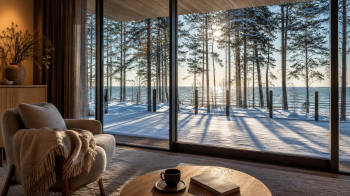
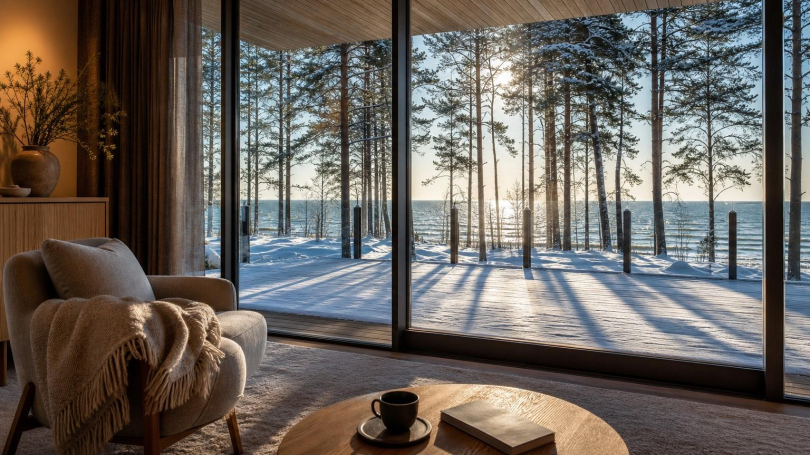
But strip away the tourist layer and what remains is something invisible in July. The beach becomes empty in the literal sense: you can walk its long stretch and meet no one but a dog on a leash and a fisherman at the water's edge. The light over the bay is different in winter: the low sun, which in summer gets lost among the crowds and parasols, here falls directly on the water and stays for the whole short day.
The pine forest, which covers almost half of Jūrmala's roughly hundred-square-kilometre territory, looks completely different in winter — no cyclists or beach bags, just forest and snow between the trunks. In snowy winters, a roughly 22-km ski trail is laid out along the beach from the mouth of the Lielupe to Jaunķemeri, with another running through the Dzintari forest park.
A morning walk along the dunes in winter needs no schedule and no company — just a warmer coat. During a strong storm, the waves of the Baltic Sea look impressive even from a safe distance, and watching from a terrace or a villa window is a pastime of its own that Jūrmala guidebooks don't usually mention.
The contrast has a statistical explanation: in summer, Jūrmala is Latvia's second most popular tourist destination after Riga. That's why the winter quiet feels so stark — it isn't the town's decline, but the flip side of that same popularity. Someone who chooses to live here in winter is choosing a town without the crowds, not a town without life.
What Operates Year-Round
Spa and Wellness
November through March is actually the main season for spa and wellness programmes in Jūrmala, not the dead season it might appear to be from the outside. Salt rooms operate, and Jaunķemeri runs programmes designed for the off-season, when beach holidays aren't relevant but recovery is. Winter spas in Jūrmala are perhaps the strongest argument against the myth of a dying resort: it's a time when treatments don't need to be booked a month ahead, and a walk after a massage takes place along an empty promenade.
The head of Jūrmala's Tourist Information Centre notes that guests from Germany and Finland come to the town specifically in winter, for calm spa breaks and wellness treatments. This shows that winter demand in Jūrmala exists and is international in nature, not resting solely on local residents. For those who treat Jūrmala as a recurring winter destination, these programmes become part of the yearly rhythm — coming here in February turns out to feel just as natural as coming in July.
Dining
Some restaurants close for winter, but not all, and the ones that stay open run at a different pace — without the summer rush and the queues at the door. The town holds a restaurant week, an event built for the off-season, when venues can present themselves without the summer crowds. On the beach, the glassed-in Simply Beach House at Pilsoņu iela 1 stays open year-round with a view of the winter sea, a place that gets lost in the summer crowds. Cafés in the centre and in Dzintari keep operating as usual, and a winter breakfast by the window overlooking an empty street is part of a local ritual that visitors rarely know about.
Culture and Activities
The Dzintari Concert Hall operates in winter too, with a separate programme aimed at both adult and children's audiences. This is a layer of town life that the tourist season usually overshadows: the people who come to these winter events are neighbours, not tourists. The hall's programme is planned in advance and aimed primarily at year-round residents.
Who Lives Here Year-Round
Jūrmala's permanent residents aren't just families born here, but also Rigans who moved for a different environment and a calmer pace, and foreigners who chose the town as a base for living, not just for holidays.
For children, schools and kindergartens are within walking distance. International schools in the region accept children from foreign families too, which removes one of the main barriers for buyers who are considering a move rather than just an investment.
Why Year-Round Living Increases a Property's Value
Luxury real estate in Jūrmala was long associated almost exclusively with the summer season: buyers cared about sea views and proximity to the beach, while building systems remained a secondary concern. That logic is gradually changing.
A house meant for permanent living is valued differently than one meant for two summer months. On resale, it appeals to a wider circle of buyers: alongside those looking for a summer residence are those who choose to live in Jūrmala year-round, and this second group of buyers keeps growing.
Long-term off-season rental turns a property from an asset that sits idle for nine months into one that works all year round, and that also changes how an owner plans maintenance costs.
If a residence in Jūrmala is considered not only as a summer house but also as year-round housing, the selection criteria change: heating, the house's orientation toward light during short days, and the plot's shelter from wind all become important. In the VIP REAL catalogue, such properties are marked separately, with exactly these parameters in mind.